President Fritz Brauner called the meeting to order at 12:30.
This Week: Alden Cunningham led the Pledge of Allegiance, while Paul Watermulder gave the invocation.
Guests of the club and visiting Rotarians: There were no guests of the club, but Joe Galligan was back from North Carolina and is now a visiting Rotarian in Burlingame. He’s joined a club in North Carolina but will be here during tax season. Today’s speaker, Mitch Postel, is also a visiting Rotarian from the San Mateo Club.
Linna Golodriga was initially our lone Zoomer today, until Pete Wenger Zoomed in during the presentation.
Doug Person welcomed BHS Principal Jen Fong as a new Rotarian. Congrats and welcome Jen!
Joe Galligan let us know that longtime and beloved Burlingame Rotarian Pierre Bouquet passed away last Thursday. President Fritz then regaled us with some funny stories about Pierre and his reports about the Golf Tournament in years past. President Fritz, Jerry Winges, and Pierre also engaged in some shenanigans related to a prior Debunking program. Pierre will be missed!
The Burlingame’s Got Talent Committee is planning a great evening. The event is April 30, 5-8 p.m., in the Sequoia Room at the Burlingame Community Center.
Christine Krolik explained that you can go to
https://www.burlingamerotary.org/ to buy tickets. There will be food from a variety of Burlingame restaurants, a signature cocktail, and a talent show. Can you sing? Dance? Play music? Tell jokes? Recite poetry? Make sure you sign up to participate. All funds raised will go to the Club’s Service Fund.
Program: Marilyn Orr introduced today’s speaker, Mitch Postel, President of the San Mateo County Historical Association (SMCHA) and a Director since 1984. Mitch manages the operation of three museums: the Sanchez Adobe of Pacifica, the Woodside Store in Woodside, and the San Mateo County History Museum in the “Old Courthouse” building in Redwood City. He oversees the Association’s archives and library, three dimensional collections, exhibits, education programs, publishing projects, fundraising, and marketing. He has published six books on local history. He has also completed two studies for the National Park Service regarding its historic resources in San Mateo County. Mitch sits on the San Mateo County Historic Resources Advisory Board and is a past Chair of the San Mateo County/Silicon Valley Visitors and Convention Bureau.
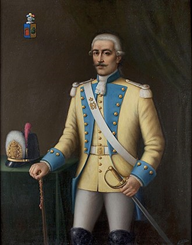
Mitch’s topic was Captain Juan Gaspar de Portolá and his expedition and discovery of San Francisco Bay in 1769. Before talking about Portolá and his expedition, Mitch shared with the group some history on Christopher Columbus’ discovery of the New World in 1492 and later expeditions to California and the West Coast.
In 1542, Juan Cabrillo led the first European expedition that explored what is now the West Coast of the United States. Cabrillo was searching for the seven cities of great wealth that some believed were near the Pacific Coast and for a route connection from the North Pacific to the North Atlantic. He also worked to map the California coast and got as far as Monterey Bay. After Cabrillo’s death in early 1543, his crew sailed on, possibly reaching Oregon before returning south.
In 1601, the Spanish viceroy in Mexico City appointed Sebastian Vizcaino general-in-charge of an expedition to locate safe harbors in Alta California for Spanish ships, known as Manila galleons, to use on their return voyage to Acapulco from Manila. Vizcaino was also given the mandate to map in detail the California coastline that Cabrillo had explored 60 years earlier. On November 10, 1602, Vizcaino entered and named San Diego Bay. He then headed north, eventually reaching Monterey Bay and then Cape Mendocino.
Captain Gaspar de Portolá was called to the New World help determine a way to hold onto California and prevent the English and Russians from taking over. One element of the strategy involved developing the mission system, which started in the north in Monterey and went down to San Diego, with each mission a day’s walk apart. This would prevent the territory from being claimed by foreign powers.
Portolá set out by land in January 1769 from La Paz, Baja, California, and reached San Diego Bay in June 1769. When the expedition got to Monterey Bay, they didn’t recognize it as it didn’t look like Vizcaino’s charts from the early 1600s. They kept going in search of Monterey and got to what is now San Mateo County in October 1769. Along the way, they camped in or near present-day Año Nuevo Purrisima Falls, Half Moon Bay, and Montara Mountain. Eventually, they saw the Farallon Islands and realized they had overshot Monterey Bay.
On November 2, 1769, Portolá sent out a hunting party looking for game. They got to the top of what’s now Sweeney Ridge and saw the San Francisco Bay. They also saw a lot of smoke, which was from the campfires of Native Americans on the bayside of the coastal mountain range.
On November 4, 1769, Portolá and the rest of the party got to the top of the ridge and “discovered” San Francisco Bay. This discovery ushered in Spanish colonization of the area. After seeing the Bay, Portola and his team turned east and south instead of heading up towards the Golden Gate. He came back the next year, and one of his team discovered the Golden Gate in 1770. Five years later, the ship San Carlos was the first European ship to sail through the Golden Gate.
Thanks to Mitch for an interesting history lesson and to Wikipedia for filling in some gaps!
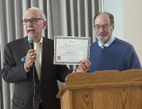
President Fritz closed out the meeting at 1:30 after thanking Mitch and presenting him with a certificate noting that Burlingame Rotary is donating polio doses in Mitch’s name.
To view this meeting, use the link below:

Our very own Burlingame Rotarian,
Mark Lucchesi has started a podcast for the
Burlingame Historical Society called "
Burlingame is a Small Town." He has interviewed a number of Burlingame Rotarians as well as other prominent folks in our community. You can check out his YouTube podcasts
here.