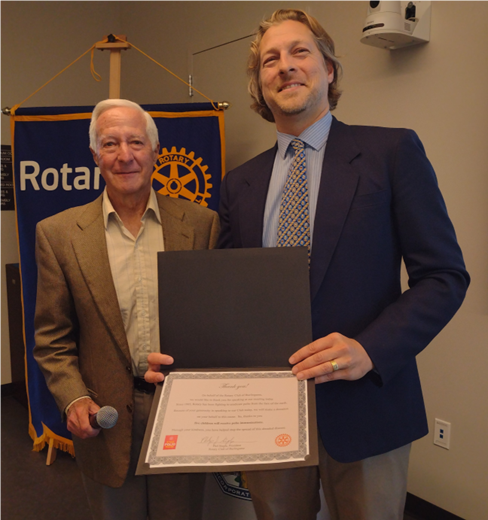
Thought for the Day: Michael Brownrigg shared his concerns about recent attacks on educational institutions and science, drawing parallels to historical events in China and Europe where knowledge was suppressed. He recounted how China's isolationist policy in the 15th century led to its decline, while the preservation of knowledge during the Dark Ages by monks and Arab scholars helped prevent a similar fate in Europe. Michael concluded by emphasizing the importance of preserving knowledge to prevent ignorance, fear, hatred, and violence.
Visiting Rotarians: Charlene Drummer introduced Bob Hermann and Dan Joraasntad visiting us from San Francisco #2 club. Bob is the current President and Dan is part of their international service committee and grants committee. She announced that the SF #2 Club is very generously donating an additional $4,000 to our third India Tribal Girls School Project.
Bill Tiedeman is home battling non-Hodgkins Lymphoma and sent a nice note explaining it seemed to come out of the blue from nowhere in February. But he is responding well to chemotherapy and appears to be in good spirits, just cannot handle crowds. He hopes to be back to the Club in the summer. A card was passed around to wish him well.
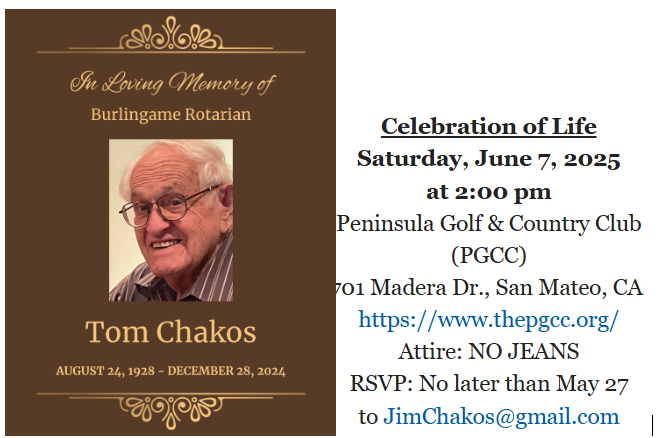
Tom Chakos, a long-time important member of our club, passed away on December 28. A memorial will be held at 12:00 PM, June 7, at First Presbyterian Church in Burlingame. This will be followed by a Celebration of Life at 2:00 PM at Peninsula Country Club and everyone is invited. Please RSVP from our Rotary website: www.rotaryburlingame.org
Bob Doerr updated us on the $100,000 cash gift that was given to our Club, to support efforts to vaccinate 10,000 girls in India with the HPV vaccine. We also applied for and received word that the Rose Stone Foundation has made a matching gift of $15,000 to the other cash donations we have received from other donors including Bobba’s family toward the HPV project. We are working with the Host Club in Vijayawada, India, and with the grant officer in charge at Rotary International in Chicago to meet the stringent requirements of the Rotary Foundation in order to receive the Foundation Grant matching funds.
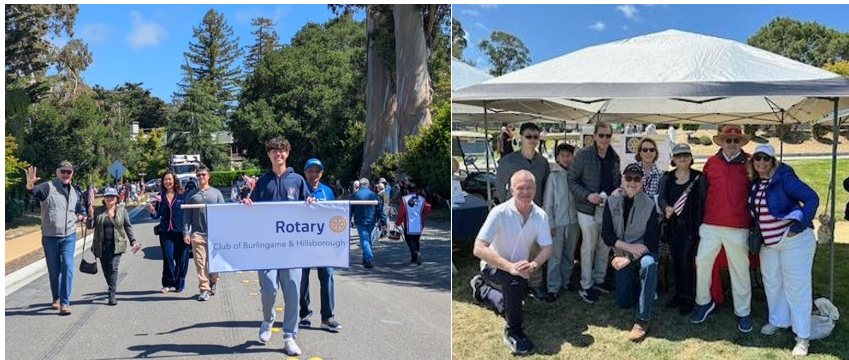
We had a good turnout for the Hillsborough Memorial Day Parade. A group from our Club marched with our banner ahead of Sean Williams’s Ferrari in the parade. We also staffed a Rotary Club of Burlingame & Hillsborough table with information for seeking new members.
Community Service Grants:
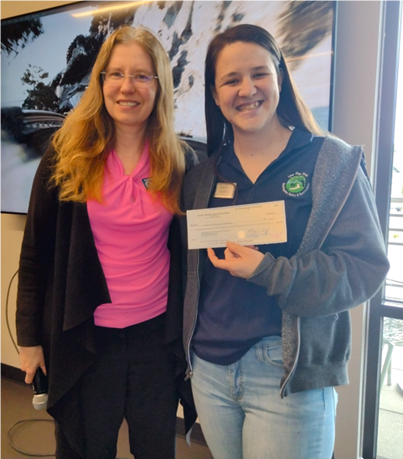
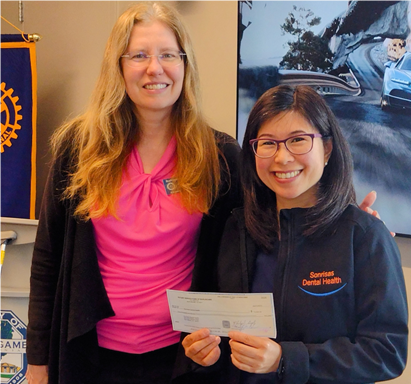
Jennifer Pence helped present checks to our local charities.
Molly Kaplan of Burlingame Parks and Rec received a check to support Camp Burlingame, a summer camp for kids. This year in addition to the typical camp activities they will be integrating some learning sessions and STEM projects. Molly thanked the Club for the generous donation.
Bonnie Jue of Sonrisas Dental Health received a check to support their wonderful program of free dental screening for those in need. She detailed their community outreach efforts, including free dental screenings, oral health education, and the distribution of oral health kits to children. The group's recent success in assembling 3,100 oral health kits in an hour with the help of our Rotary Club was noted, and plans for distributing these kits to children in the Big Lift summer program were discussed.
CALL Primrose is to receive their check at a future meeting for helping with their many years of providing food and groceries at no cost to those in need.
Program:
Bobba Venkatadri introduced our speaker, Dr. Anil Bahrgava who spoke on Regenerative Agriculture for Climate Adaptation & Economic Resilience.Dr. Bahgava’s resume’ is extensive and impressive. He holds degrees from prestigious universities both in the US and abroad. He has worked in many countries and has extensive experience in agricultural practices, economics and climate science.
His remarks are summarized by the following 5 topics:
Regenerative Agriculture: A Sustainable Future
Dr. Bahrgava discussed regenerative agriculture, highlighting its potential to address climate change, improve food security, and enhance livelihoods, particularly for low-income farmers in developing countries. He defined regenerative agriculture as a process-focused approach that prioritizes soil health, biodiversity, and ecosystem services, aiming for a "triple win" of improved people, planet, and profits. He traced the evolution of agricultural practices from the Green Revolution to the emergence of regenerative agriculture in response to climate change and environmental concerns, emphasizing its focus on regenerating the land and improving rural communities.
Regenerative Agriculture Practices and Challenges
Dr. Bahrgava shared his extensive experience working on regenerative agriculture projects across various countries, including India, Tanzania, Nicaragua, and Peru. He highlighted practices such as vermiculture, agroforestry, and microdosing as effective methods for improving soil health and increasing agricultural productivity. He also discussed challenges like deforestation, crop residue management, and the importance of choosing the right places to apply fertilizers for maximum impact. He concluded by mentioning his current work on academic projects, corporate ESG initiatives, and collaborations with NGOs and governments to promote regenerative agriculture practices.
Regenerative Agriculture: Benefits and Challenges
Dr. Bahrgava discussed practices like rotational grazing, agroforestry, and soil carbon sequestration, using examples from Belize and Colombia. He emphasized the business case for regenerative agriculture, noting its potential for profitability and its suitability for international development projects. He also addressed the challenge of bridging the short-term yield gap between traditional and regenerative agriculture, highlighting the need for economic incentives and support for farmers during the transition.
Regenerative Agriculture Investment Opportunities
Dr. Bahrgava discussed the importance of investing in regenerative agriculture, highlighting various financial instruments, carbon markets, and insurance products available to support this. He emphasized the role of big data and artificial intelligence in improving climate risk assessment and market understanding. Burlingame also explained the business case for regenerative agriculture, noting its scalability and incentive compatibility, and encouraged continued conversation about food sourcing and economic considerations. He invited partnerships with farmers, agricultural organizations, NGOs, governments, and individuals to advance regenerative agriculture initiatives across the value chain.
Global Water Risk and Agriculture
Dr. Bahrgava discussed maps of global water risk and soil organic carbon content, highlighting areas like Sub-Saharan Africa and India as having high risk levels. They explored the issue of microplastics in soil and fertilizers, noting concerns about their presence in agricultural products and human health. He also addressed the relationship between factory farming and regenerative agriculture, suggesting that improvements in agricultural practices could mitigate some of the negative impacts of factory farming. The conversation ended with a mention of a donation from the Rotary Club and a brief discussion about a Nicaragua project focused on sustainable agriculture and community ownership.
Presentation of the Burlingame Citizen of the Year Award
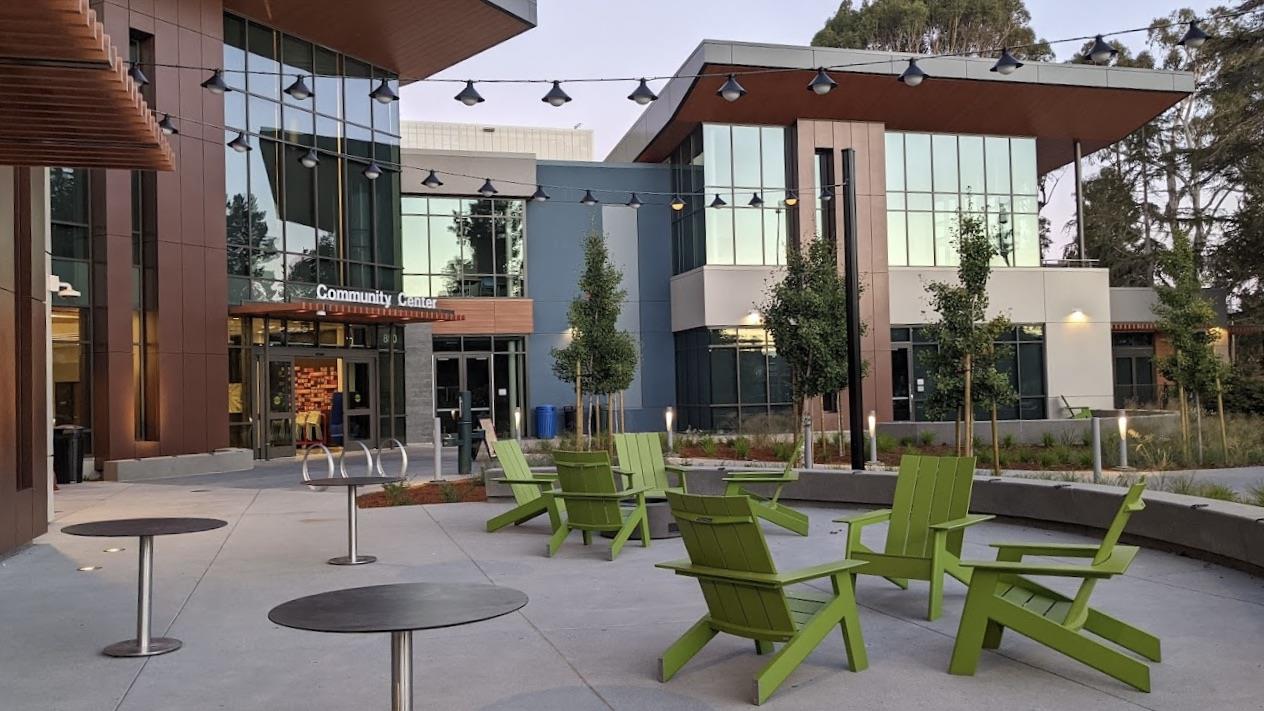
Meeting Location: Sequoia Room at the Burlingame Community Center.
We will be holding a Joint Services meeting with Burlingame Lions Club. The meeting will include the presentation of the Burlingame Citizen of the Year award.