President Cary Koh called the meeting to order at 12:27.
This Week: Ted Kruttschnitt led the Pledge of Allegiance via Zoom.
Past President Fritz Brauner led the invocation, reciting a number of quotes about communications from famous and not-so-famous authors, playwrights, and others.
- “The most important thing in communication is hearing what isn’t said.” Peter Drucker
- “The greatest problem with communications is the illusion that is has been accomplished.” George Bernard Shaw
- “Be yourself. Everyone else is already taken.” Oscar Wilde
- “We filter the past for happy memories and filter the future for gloomy prognosis.” Matt Ridley, The Rational Optimist
- “It is better to fail at originality than succeed at imitation.” Herman Melville
- “Your present circumstances don’t determine where you can go; they merely determine where you start.” Nido Qubein
- “Start where you are, use what you have, do what you can.” Arthur Ashe
- “Risk is what’s left over after you think you’ve thought of everything.” Carl Richards
- I never did give anybody hell. I just told the truth, and they thought it was hell.” Harry S. Truman
- “There’s only one way to have a happy marriage…and as soon as I learn what it is, I’ll get married again.” Clint Eastwood
Sunshine Report: Jim Shypertt reported that Maki Kobayashi just returned from Japan, and the recent earthquake didn’t affect him.
Guests of the club and visiting Rotarians: Michelle Privitera joined us from the San Mateo Club.
Announcements:
President Cary reminded everyone that Burlingame’s Got Talent is coming up on Sunday, April 21. The event will be held at the Community Center and proceeds benefit the scholarship fund. Buy your tickets soon and get ready to be entertained!
Mark Lucchesi entertained the crowd with news of March and April birthdays, anniversaries, and Rotarian anniversaries, along with nicknames for many of the honorees. Happy birthday and congratulations to all!
Past President Fritz delivered the newscast today, accompanied by a slow clap while approaching the podium. Fritz talked about the eclipse. Unfortunately, we weren’t in the zone of totality. The next total eclipse in our area will be in 2044. Mark your calendars! Fritz brought along some barely used eclipse glasses. He’s selling them for a special price.
Fritz was going to talk about taxes since it’s almost April 15, but instead he made a slight detour to talk about the movie Taxi Driver and a little pop quiz about the cast and release date.
In true Fritz fashion, he told us that today is both National Siblings Day and National Farm Animals Day. Not to be outdone, Alex Buljan let us know that it’s also National Hug a Dog Day. Your High Gear author believes that every day should be National Hug a Dog Day, at least where her pup Kiki is concerned.
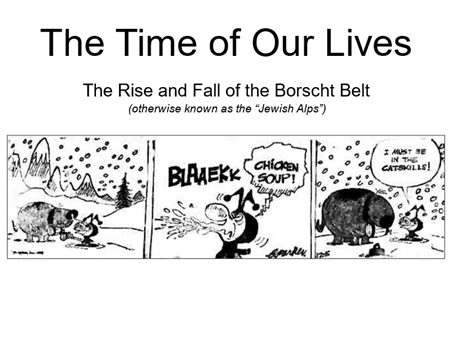
Program: President Cary introduced today’s speaker, Bart Charlow, retired Chief Executive Officer of Samaritan House. Bart is a seasoned storyteller, born and raised in the Catskills, where his family ran the Hotel Irvington in South Fallsburg. He is the author of the newly published A Catskill Carnival: My Borscht Belt Life Lived, Lost and Loved. His talk today was entitled “The Time of Our Lives, The Rise and Fall of the Borscht Belt.”
According to Bart, Dirty Dancing and The Marvelous Mrs. Maisel provide just a taste of the Catskills. The reality is wilder than anything in the movie or tv show.
The Catskills, named by Dutch settlers, are part of the Appalachian chain of mountains. The Catskills were one of the country’s first frontiers. In the 1820s, some early American authors were writing about the Catskills and setting their stories there, while the Hudson Valley painters started painting the Catskills in the around the same time.
The Delaware and Hudson Canal, which was equivalent to a super highway in the 1820s, went through the Catskills and helped open the area to trade. By the 1840s, the Catskills became known as a healthy place to go, and people with respiratory illnesses like tuberculosis went there to recuperate.
In the 1880s and 1890s, the Catskills became a resort area for people from northeastern cities like New York and Philadelphia. The wealthy built “cabins,” while the middle class built hotels. By 1903, the railroad came through, making it very convenient to visit the Catskills, which were only 90 miles from Manhattan.
The Borscht Belt is the area of the Catskills closest to New York City. In the early days, Catskills resorts had signs saying, “no Hebrews”. Simultaneously, there was a large influx of eastern Europeans settling in New York City and nearby areas. Jewish philanthropists were funding Jewish farming settlements all over the world, including in the Catskills. The Catskills weren’t well suited to farming due to the weather and terrain, so the farmers ended up turning their farms into small hotels and resorts that welcomed Jews. As the Jews arrived, gentile resort owners moved out, and the area became a Jewish enclave with giant hotels with amenities like pools, golf courses, shopping centers, etc.
By the 1950s, the Catskills featured the largest concentration of hotel rooms anywhere in the world. More than 50,000 rooms were available, and there were almost 2,000 hotels and bungalow colonies in the hotel association. In the summer, the small towns in the area would host one million visitors for the season.
According to Bart, the Borscht Belt’s heydays in the 1920s and 1950s/1960s were fueled by crime (Bugsy Siegel and other members of Murder Inc. were visitors), entertainment (Robert Klein, Jerry Stiller, Jerry Lewis, Sid Caesar, etc.), food (hotels offered the American Plan—three meals a day included in the price of the stay), and sex (more on that below).
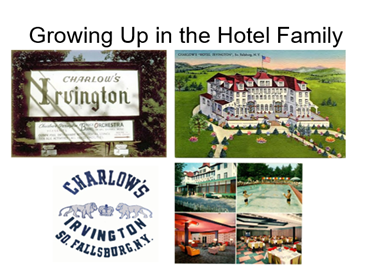
Bart grew up at his family’s Charlow’s Hotel Irvington in South Fallsburg, New York. Bart’s family was one of the original hoteliers, starting with a farm first, then buying a hotel. They had 10 buildings, 150 hotel rooms, and 65 bungalows. Their property offered the American Plan, entertainment seven days a week, pool and athletic facilities, and a day camp for the kids. The Hotel Irvington was also one of the first in the area to integrate its staff.
At most resorts, the staff and guests don’t mix. In the Borscht Belt, the guests and staff were expected to mix and mingle. The bungalows were rented for the whole summer. Men would stay in New York City and work all week, then come up on Friday for the weekend. The wives and kids would stay there all week. Key parties were not uncommon….
Before its decline, the Borscht Belt made significant contributions to American culture.
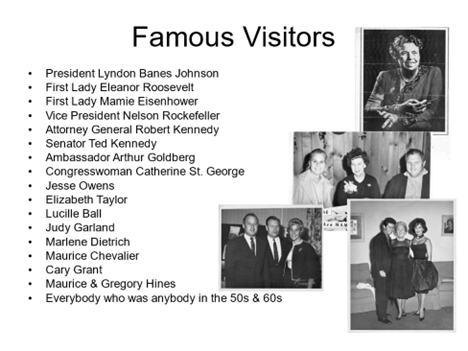
Comedians, singers, musicians, and variety acts played the Catskills. Famous athletes also trained, worked, and/or appeared in the Catskills. Presidents, First Ladies, and other politicians visited the area. Many movies were set in the Catskills including
Sweet Lorraine, Walk on the Moon, Dirty Dancing, Mr. Saturday Night, Taking Woodstock, and Marjorie Morningstar.
By the late 1960s, the area was in serious decline. Food and entertainment costs made it too expensive to keep operating, and cheap jet travel allowed people to travel to Europe and other places. The nail in the coffin was the Civil Rights Act of 1964, which made restrictions on accommodations illegal. Jews could now stay anywhere, not just the Catskills, so many of the hotels went bankrupt as people vacationed elsewhere.
Although most of the hotels are gone now, you can read more about them in Bart’s book A Catskill Carnival: My Borscht Belt Life Lived, Lost and Loved or in his newly released companion book Pickle Barrel Tales: More Borscht Belt B.S., which was released on April 12.
President Cary closed out the meeting after thanking Bart and presenting him with a certificate noting that Burlingame Rotary is donating polio doses in his name.



 Our very own Burlingame Rotarian, Mark Lucchesi has started a podcast for the Burlingame Historical Society called "Burlingame is a Small Town." He has interviewed a number of Burlingame Rotarians as well as other prominent folks in our community. You can check out his YouTube podcasts
