We were back in our usual location, the cozier Elm Room. President Doug began the meeting by asking Joe La Mariana to lead us in the Pledge of Allegiance. He then called on President-elect Jerry Winges to deliver his “thought of the day”. He discussed community service as a form of quiet revolution and shared his thoughts on the importance of selfless service and lifting others.
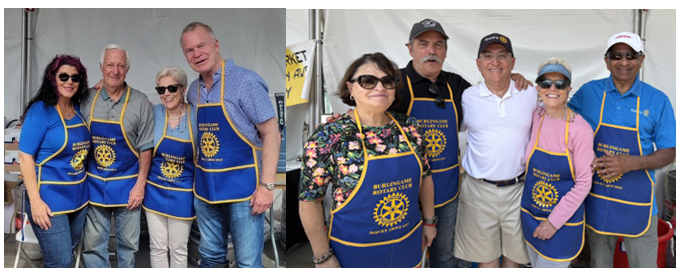
Chamber of Commerce CEO Susan Baker expressed her heartfelt gratitude to the Rotarians who served wine and beer at the Burlingame on the Avenue event over the weekend.
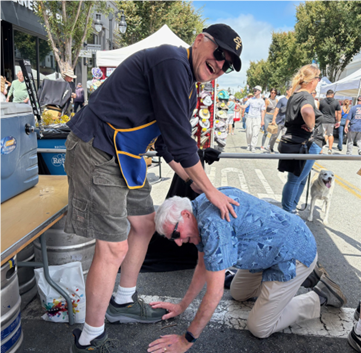
Not pictured were Doug Person, Bob Doerr and Jerry Winges who also “manned” the booth. In order to demonstrate the deference that should be accorded to a Rotary Club President, Jerry bowed down to current President Doug.
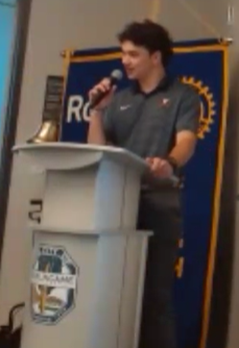
Jennfer Pence took the microphone to introduce one of our 4-Year Scholarship recipients. Johnny Willey, a fourth-year University of Virginia student majoring in economics on the pre-med track. He expressed gratitude for the Rotary Club scholarship, which has supported his education. He shared his academic achievements, including his recent MCAT preparation and involvement in the Granger Lab, where he manages bioinformatics for single-nuclei RNA sequencing. Outside of academics, Johnny is active in jazz music, playing in various ensembles and a fraternity, and he plans to return to Virginia after a brief break.
Program:
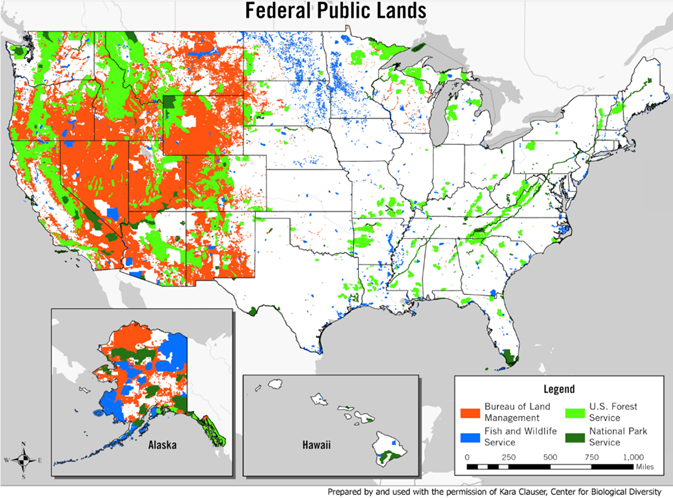
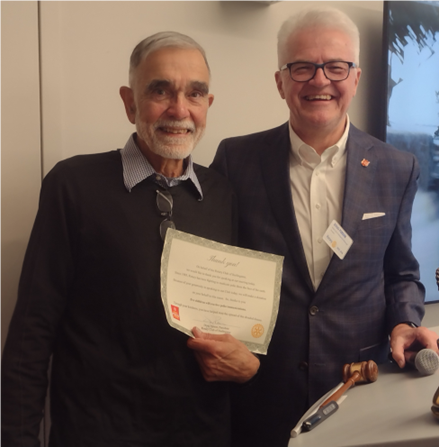
Doug Person introduced our speaker, John Leshy, an expert on national parks and public lands, who spoke about the history and contemporary relevance of America's public lands.
Dr. Leshy discussed the history and management of public lands in the United States, emphasizing that these lands were acquired and protected through bipartisan political decisions rather than land grabs. He highlighted key legislative acts such as the Weeks Act of 1911 and the Alaska National Interest Lands Conservation Act of 1980, which expanded federal land ownership and protected natural areas. Burlingame also addressed myths surrounding public lands, including the false narrative that native Americans were displaced to create national parks, and explained how native American tribes and conservation groups have increasingly influenced public land policies.
Dr. Leshy explained the historical context of federal land management, noting that Congress has had complete power over federal property since the Civil War, with the Supreme Court rarely intervening. He discussed President Trump's actions regarding national monuments, including the reduction of protections in Utah, but emphasized that Trump ultimately did not pursue further land reductions after facing significant political opposition. He highlighted the recent Reconciliation Act, which included a controversial amendment proposed by Senator Lee to sell off 3 million acres of federal land, but the amendment was withdrawn due to widespread opposition across party lines.
He then discussed the Trump administration's approach to public lands, including the release of millions of acres for oil and gas development and budget cuts to federal agencies. He expressed concern that these actions could lead to the transfer of public lands to private entities, though the outcome remains uncertain.
Rick Harrell will give a compelling talk on the powerful intersection of medicine, technology, and music therapy—and how these tools are being used to support veterans facing a wide range of service-related challenges. Drawing on more than a decade of experience, Rick will share moving personal stories from his work with veterans in VA hospitals and homes, residential PTSD programs, psychiatric intensive care units, the San Francisco County Jail, and San Quentin State Prison.