Pledge of Allegiance
After ringing the bell and calling the meeting to order, President Doug Person asked Dennis Zell to lead us in the Pledge of Allegiance.
Invocation Peter Wanger Jr. offered an invocation grounded in a simple but resonant philosophy about life. He reflected that the best things in life are not material possessions, but the experiences that create happy and lasting memories. He also noted that those experiences become even richer when shared with people we care about, and that life’s tragedies become easier to bear when we are supported by others. He concluded with the thought that, in any journey, what matters most is the company we keep.
Visitors
Several guests were warmly welcomed to the meeting, reflecting the club’s strong spirit of fellowship and community outreach. A prospective guest, Sandy Kaur, shared that she had been drawn to Rotary through its positive reputation and visible service in the community and expressed enthusiasm about becoming involved. Raziel Unger was introduced as a special guest with longstanding Rotary ties, including a formative Rotary-sponsored exchange to Sweden and a family history deeply connected to the organization. Past President Emily Matthews was also welcomed back, and Nuha Alhindi from SERVPRO attended as both a sponsor for the upcoming talent event and a former Rotary incentive scholar whose return highlighted the enduring impact of the club’s support for young people.
Sunshine Report
The Sunshine Report centered on meaningful and heartfelt requests for support. Delia Montano shared an emotional update about her son, who has faced an extended and devastating medical recovery following a serious accident and, most recently, another difficult health episode. She asked the club to keep him, and his young children, in their prayers. Anita Dukes shared that Jonnie’s mother is in very fragile condition and asked members to remember their family in their thoughts and prayers. The report served as a reminder of the compassion and care that define the club’s culture.
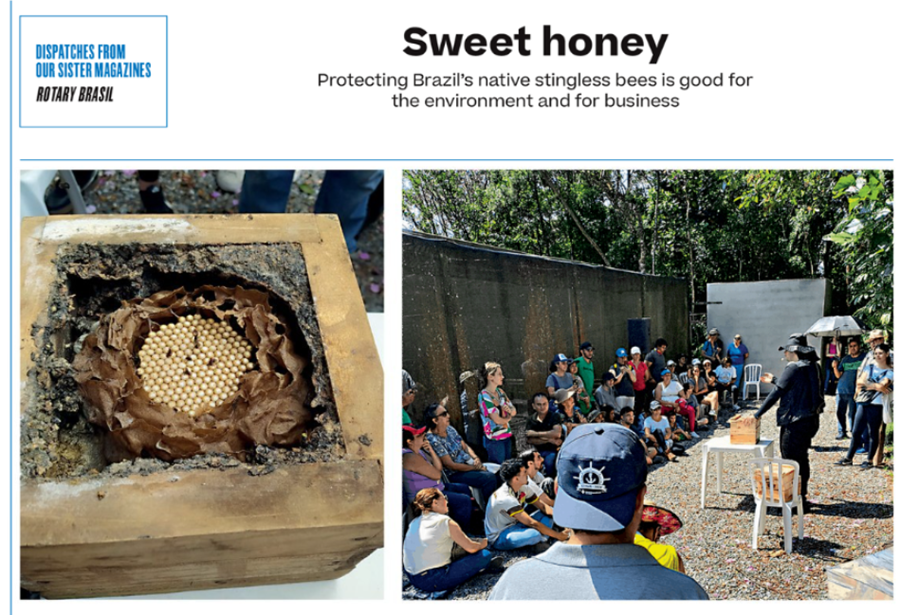
Rotary Magazine This Month Jay Miller once again encouraged members to take full advantage of Rotary magazine as a way of staying connected to the broader Rotary world. He highlighted page 54, “Sweet Honey,” which focuses on honeybees and pollinators, and also drew attention to page 40, which explores Rotary’s global presence and notes that the United States has the largest number of Rotary clubs, followed by India. Jay’s message was both practical and enthusiastic - members were encouraged not to leave the magazine behind, but to take it home, read it, and use it as a window into Rotary’s reach and relevance around the world.
Announcements Marilyn Orr reminded members that the club has 19 applicants for its scholarship program and asked for volunteers to help with interviews on April 20 and 21 from 2:00 p.m. to 5:00 p.m. This is a process that is both enjoyable and rewarding, and that broader participation helps strengthen the selection process. Christine Krolik urged members to purchase tickets for Burlingame’s Got Talent (and Hillsborough too!) - so final planning can be completed with confidence, particularly around food and attendance.
Robert Doerr also requested volunteers to assist with food pickup and delivery for the event, noting that dependable logistical support will be essential to the evening’s success.
Birthdays and Anniversaries
The meeting included the club’s customary recognition of birthdays, anniversaries, and Rotary membership milestones, all shared with humor, warmth, and appreciation. Members and spouses from both March and April were acknowledged, including personal birthdays, wedding anniversaries, and significant Rotary service anniversaries. Longstanding membership milestones, including Marilyn Orr’s 38 years and Bob Doerr’s 39 years in Rotary, highlighted the remarkable continuity, loyalty, and fellowship that continue to define the club.
Program
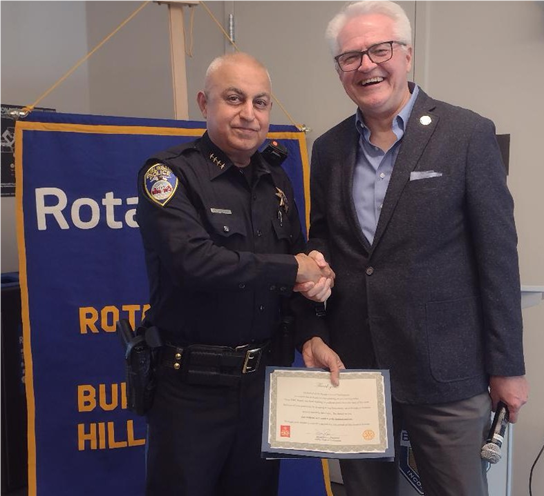
City Manager Lisa Goldman introduced Raj Vaswani as Burlingame’s police chief on Wednesday, portraying his selection as the outcome of a broad and competitive search and describing him as a leader whose experience and temperament matched the city’s civic culture. Goldman pointed to his decades in law enforcement, much of it in San Francisco, and said he had emerged as the clear choice for a role that carries both operational and symbolic weight in a small, highly engaged community.
In his remarks, Chief Vaswani traced his interest in policing to childhood, saying he had decided in elementary school that he wanted to become an officer and then followed that path through cadet work, criminal justice studies at San Jose State and a long career in the San Francisco Police Department. He framed that trajectory not as a matter of circumstance, but as a sustained personal commitment. The story he told was one of continuity: a career built over decades around a profession he said he had chosen early and never abandoned.
Vaswani also cast Burlingame as a deliberate destination rather than a late-career landing spot. He described the city as embodying elements of the Bay Area he remembered from his youth - close-knit, community-oriented and defined by a strong local identity. Burlingame, he said, appealed to him in part because of its downtown character and its sense of place, qualities he suggested have become harder to find in a region remade by growth and change.
He used his speech to sketch the breadth of his background, moving through patrol, undercover assignments, investigations, command posts and senior leadership. The cumulative effect was to present himself as an official shaped by many versions of police work, from street-level encounters to administrative decision-making. He spoke of difficult assignments and demanding cases not for dramatic effect, but to underscore that his understanding of public safety had been formed in varied and sometimes punishing settings.
The clearest theme in his remarks was a philosophy of visible, relationship-based policing. Vaswani said he wants officers out of their vehicles and in regular contact with residents, arguing that public trust is built not only in moments of crisis, but through routine familiarity. He spoke of walking beats, casual conversations and everyday contact as essential tools of modern policing, suggesting that a department cannot build confidence if it remains physically and psychologically distant from the people it serves.
At the same time, he offered a measured assessment of local conditions. Burlingame, he said, is a low-crime city, though not one without crime. Officers still encounter guns, impaired drivers and organized retail theft, he said, and the department remains focused on staying ahead of those problems. His account was reassuring, but not complacent, and reflected an effort to acknowledge the city’s relative safety without overstating it.
Vaswani returned repeatedly to the need for preparation. He said effective policing requires anticipating change rather than reacting to it, whether that means monitoring calls for service, studying development trends or learning from the experiences of neighboring jurisdictions. He also identified staffing as a central challenge, particularly in a region where housing costs and generational shifts have made recruitment and retention more difficult. A successful department, he suggested, must offer more than a paycheck; it must provide purpose, opportunity and a culture in which officers feel invested.
During a question-and-answer session, Vaswani addressed a range of concerns more practical than philosophical. He spoke about regional cooperation in responding to financial and technology-enabled crimes, defended the use of license plate reader systems while emphasizing privacy safeguards and acknowledged residents’ concerns about traffic enforcement and unsafe e-bike use. His answers were methodical and managerial in tone, reflecting an approach centered on implementation, coordination and public accountability.
He closed with a modest appeal to the audience: thank the public employees who serve the city. Such gestures, he said, matter more than people may realize. It was a small point, but one that neatly captured the broader message of his talk. Vaswani presented policing not only as a matter of enforcement, but as a civic partnership, one grounded in presence, trust and the day-to-day work of sustaining community life.
The Peninsula Health District is partnering with Blue Zones to conduct an Ignite Assessment—a research-based effort to understand our community’s well-being and readiness for lasting change. Inspired by the world’s longest-lived populations, Blue Zones uses proven strategies to improve health, lower costs, and enhance quality of life. This phase focuses on listening—engaging residents and leaders to uncover strengths, gaps, and opportunities. Join us to learn how this work could shape a healthier future for San Mateo County.