President Doug Person called the meeting to order.
Dan Conway led the Pledge of Allegiance.
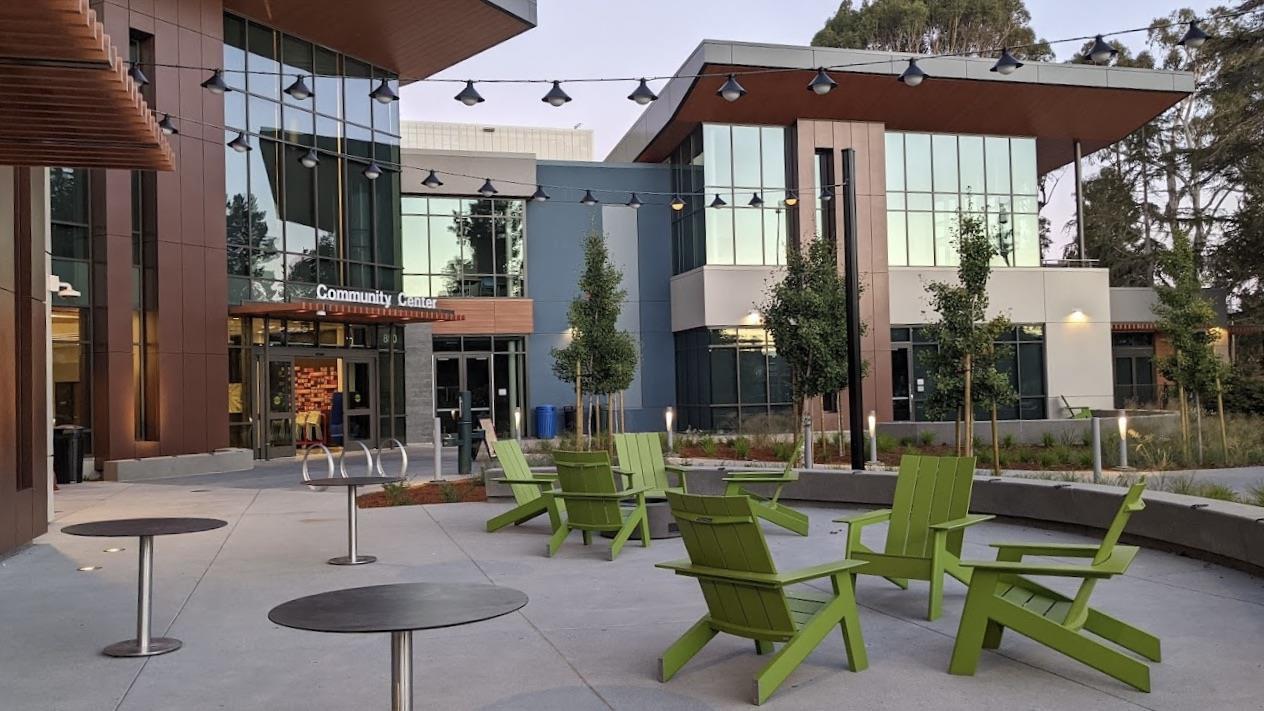
Jay Miller delivered the invocation. He reminisced about the various locations where the Burlingame/Hillsborough Rotary has met in the past—the Hilton Hotel, two golf courses, then to the spectacular Burlingame Community Center. It is truly a community center. People see the Rotarians meeting here and being an integral part of the community.
Visiting Rotarians and Guests: Former Rotarian Joe Galligan joined us and noted that he was a longtime Board member for Community Gatepath (the former name of AbilityPath). Dan Conway introduced former County Supervisor Dave Pine. Paolo and Laila Filho joined for their second visit and brought two guests, Emerson Alves and Savash Koc. Oliver Brown joined for his second visit. Paul Watermulder introduced his wife Genie, who is active with AbilityPath.
Announcements:
Sunshine Report:Paul Watermulder noted that Bobba Venkatadri’s wife is back in Stanford Hospital for the second time. We extend our best wishes to both.
Jerry Winges announced that there is a celebration for Burlingame’s new Town Square on April 25 from 11 am to 2 pm. We plan to have a table there to help market the club.
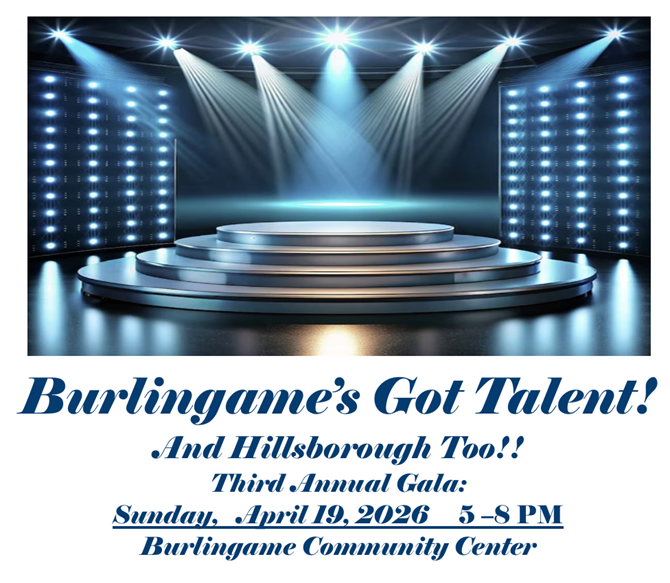
Marilyn Orr talked about Burlingame’s GotTalent, which is on April 19. You can buy your tickets on the Rotary website. We need sponsorships and talent. Please sign up!
Upcoming Programs: President Doug reviewed the presenters for the next two meetings: Prof. Ronjon Nag, President of the R42 Group, who will discuss AI and Aging, and Kyra Hall with the Contractors State License Board, who will discuss what every homeowner should know before hiring a contractor—and how to protect yourself from construction fraud and more.
Program
Marilyn Orr introduced Bryan Neider, whose career spans 35 years in technology and finance, including 25 years at Electronic Arts, where he served as Chief Operating Officer for a time. He now serves as CEO of AbilityPath. Bryan is passionate about leveraging innovation and technology for good.
Bryan’s presentation was entitled “Welcome to the Intelligence Revolution.” In December 2025, Bryan projected that 2026 would be the year of proving the impact of AI. Things have changed dramatically since that projection.
According to Bryan, just two months into the year, the structural shifts have been more disruptive and rapid than expected. We are now living in a new era of accelerating change unfolding at a dizzying pace each day. By the time a standard 20-minute Rotary presentation ends, over 1,000 new AI-driven tools will have been released worldwide, and with the new capabilities of tools such as Claude Code, these numbers will only increase. We are moving at lightning speed from "Assistive AI," chatbots that help us draft emails, to “Agentic AI." These autonomous agents operate under human-set goals, with the AI executing the entire workflow, from complex research to verification.
This shift is manifesting in ways that once felt like science fiction:
Bio-Cloud Computing: Using lab-grown human brain tissue as biological processors to bypass the energy constraints of traditional silicon.
The Human API: A world where AI agents hire humans via platforms like “RentAHuman" to perform physical tasks or bypass digital security.
Capital Concentration: The AI stack alone represents a $10.8 trillion economy, ranking it as the third- or fourth-largest economy globally.
AI is fundamentally reshaping service delivery for community-based organizations. More than half of local nonprofits operate on budgets of $1M or less, and they risk being left behind by a widening digital divide. The question isn't whether AI will transform the nonprofit sector; it's whether they will lead that transformation or be replaced by it.
At AbilityPath, their goal is to use AI tools to better serve their clients, automating the "boring" work so staff can focus on the "human" work. Nonprofits can support their work by considering:
Bryan reviewed several AI tools that AbilityPath is using to serve more clients and be more effective.
Greenhouse for Talent: AI-driven hiring and onboarding tools have reduced our open-to-hire time by 50%.
Ocean Friends EMR: A new clinical system for children’s therapy that automates documentation, enabling us to serve an estimated 20% more children each week.
Enrollment Chatbot: A 24/7 tool that helps families navigate the complex landscape of adult services, ensuring they feel heard and valued.
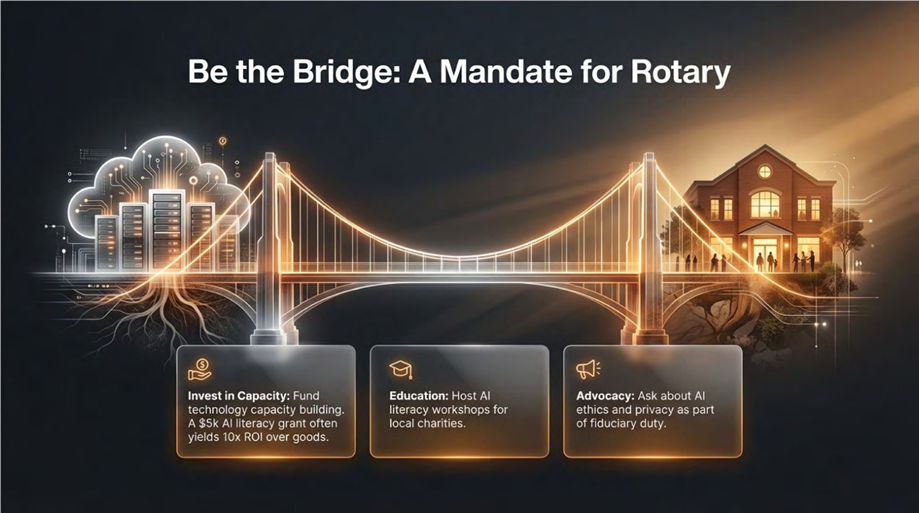
Bryan had the following recommendations for Rotary:
He said that AI won’t replace nonprofits, but nonprofits that use AI will replace those that don’t.
After his presentation, Bryan answered questions about AI from the audience.
Dave Pine mentioned a class on AI that he’s taking at Stanford:
Introduction to AI: What It Is, How It Works, and Why It Matters
The course meets for 1.5 hours per week over six weeks starting on April 20th. It doesn’t require any technical knowledge.
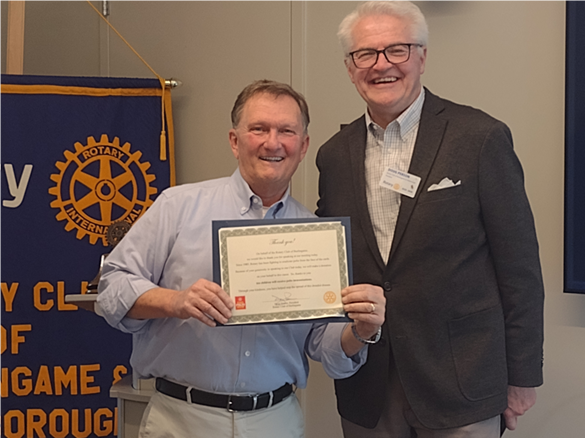
President Doug adjourned the meeting after thanking Bryan and presenting him with a certificate noting that Burlingame Rotary is donating polio doses in his name.
AI is making it possible to design systems and vaccines that target the biology of aging, not just specific diseases. These systems could help prevent multiple age-related conditions at once, shifting medicine from treatment to prevention. We investigate the state of the art of AI and its applicability to tough problems like aging and cancer.